Daylight, twilight and sun times in Ranua, Finnish Lapland
Daylight, twilight and sun times in Ranua, Finnish Lapland

Many travellers wonder: is Lapland completely dark in winter?
The answer is no. Even during the shortest days of the year, Lapland isn’t covered in darkness – it glows.
In Ranua, just south of the Arctic Circle, the sun barely rises in December, yet the snow and
twilight reflect enough light to create a soft, magical brightness throughout the day.
What’s often called the Polar Night isn’t pitch-black; it’s a season of calm light and deep silence.
Lapland daylight in December – how short are the days really?
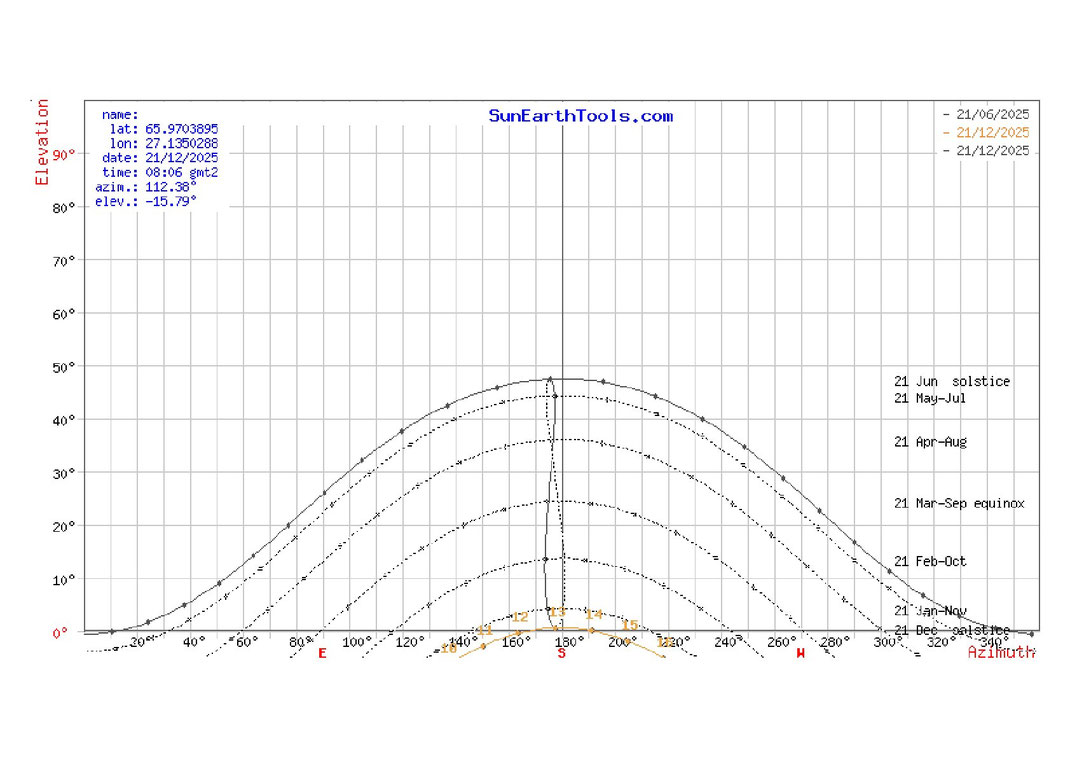
On 21 December, the winter solstice, the sun rises in Ranua around 11:45 a.m. and sets again at 2:33 p.m.
That’s only 2 hours 48 minutes of direct sunlight.
At its highest point, the sun reaches just 0.6 degrees above the horizon – barely a hand’s width.
Yet the real experience is longer.
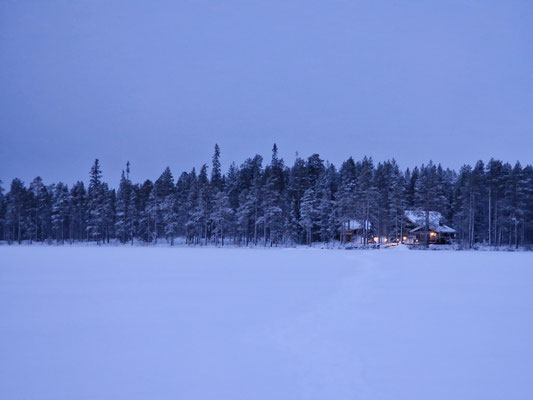
From 10 a.m. until about 4 p.m., the sky stays bright thanks to civil twilight, when the sun
is below the horizon but still lights up the snow.
That means up to six hours of usable daylight for walking, photography or outdoor adventures – far more than most expect.
The snow acts like a natural mirror, amplifying every bit of light. The result is a surreal, gentle glow rather than darkness.
Twilight in Lapland – when darkness turns to colour
Winter light in Finnish Lapland is not about brightness, but about colour.
Morning and evening merge into one long blue and pink hour, stretching across the frozen landscape.
The low sun filters through ice crystals and clouds, creating reflections of gold, violet and deep blue.
In Ranua, there’s no sudden sunrise or sunset – just a slow transformation of light, a continuous twilight that invites
stillness.
Even on overcast days, the snow captures enough light to make the world shimmer. And when night finally falls, the Northern Lights often take
over.
Sun times in Ranua – month by month
The table below shows how daylight and twilight hours change throughout the year in Ranua (65.97° N).
It helps you plan your trip and know when it’s bright enough for activities or photography.
| Month | Avg. Sunrise | Avg. Sunset | Daylight | Usable Light incl. Twilight |
|---|---|---|---|---|
| January | 10:00 | 14:50 | 4 h 50 min | 6 h 30 min |
| February | 08:20 | 16:55 | 8 h 35 min | 10 h 30 min |
| March | 06:30 | 18:35 | 12 h 05 min | 13 h 45 min |
| April | 05:15 | 21:05 | 15 h 50 min | 17 h 30 min |
| May | 03:30 | 23:30 | 20 h 00 min | nearly 24 h (Midnight Sun begins) |
| June | – | – | 24 h daylight | 24 h twilight brightness |
| July | 02:45 | 23:15 | 20 h 30 min | 22 h usable light |
| August | 04:30 | 22:00 | 17 h 30 min | 19 h usable light |
| September | 06:30 | 19:45 | 13 h 15 min | 15 h usable light |
| October | 08:00 | 17:15 | 9 h 15 min | 11 h usable light |
| November | 09:15 | 14:30 | 5 h 15 min | 7 h usable light |
| December | 10:35 | 13:45 | 3 h 10 min | 5 h usable light |




You can see how quickly light returns after the winter solstice:
by February, the daylight almost doubles; by March, Lapland already has longer days than
central Europe.
From May to July, the Midnight Sun shines continuously above the horizon.
Why the dark season feels so peaceful
Locals call this period kaamos – not to describe darkness, but tranquillity.
The world slows down. People cook, talk, read, and spend quiet evenings together.
The light may be scarce, yet it feels abundant – soft, reflective, meditative.
Those who visit during the Polar Night in Finland often describe it as healing rather than
depressing:
time seems to expand, colours appear stronger, and silence becomes part of the experience.
Practical tip for travellers
If you plan a Lapland winter holiday, understanding the daylight hours helps you make the most of your stay:
-
In December and January, plan outdoor activities between 10 a.m. and 3 p.m.
-
The light is ideal for photography – golden tones all day long.
-
During civil twilight, visibility is still excellent; bring a headlamp only for late evenings.
For real-time sun paths and global visualisation, explore the interactive 3D model:
Conclusion – never truly dark
Lapland in winter is not a land of darkness but a landscape of quiet light.
In Ranua, where the sun hovers near the horizon, the world glows softly between night and day.
To experience these short days is to understand that light is not about brightness – it’s about presence.