
What are aurora lights?
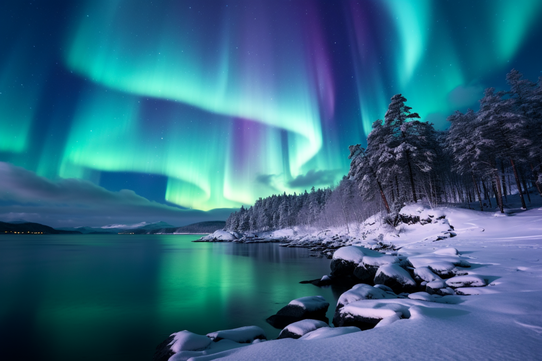
Aurora lights – known as the northern lights (aurora borealis) in the north and the southern lights (aurora australis) in the south – are colorful light phenomena that appear when charged particles from the Sun collide with Earth’s atmosphere.
Most often they glow green, but depending on the altitude and type of gas involved, they can also appear in shades of pink, violet, red, or even blue.
How do aurora lights happen?
The Sun constantly emits streams of particles called the solar wind. When these particles reach Earth, they are directed toward the magnetic poles. At altitudes of 100–200 km, they interact with oxygen and nitrogen in the upper atmosphere – and the sky lights up.
-
Green: oxygen at ~100 km altitude
-
Red: oxygen higher than 200 km
-
Violet/blue: nitrogen molecules
This is why auroras are strongest around the Arctic Circle, where Earth’s magnetic field funnels the particles into narrow, glowing bands.
When do aurora lights occur?
Best times of year
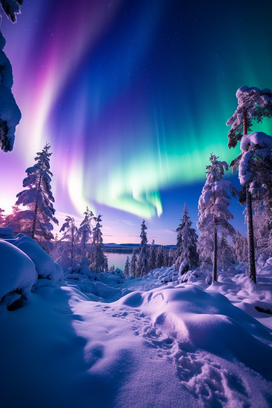
Auroras are active all year, but visible only in darkness. That means September to March is the prime season in Finnish Lapland. Autumn brings the first displays against darkening evenings; mid-winter offers the coldest, crispest skies; and late winter (February–March) combines long days with clear, dark nights.
Best time of night
The auroras can appear any time it’s dark, but statistically the most active window is 10 PM to 2 AM. This is when geomagnetic activity peaks – your best chance for vivid, dancing displays.
Where are aurora lights found?
The role of light pollution
Auroras need darkness. In cities, streetlights drown them out. The best viewing conditions are in remote, open areas – frozen lakes, forest clearings, or the tops of fells where the horizon is wide and unobstructed.
Best regions in the north
-
Finnish Lapland: among the world’s top aurora destinations, with up to 200 nights a year of visible northern lights.
-
Other hotspots: Norway, Sweden, Iceland, Alaska, and northern Canada.
Weather and sky clarity
Clear skies matter as much as solar activity. A crisp, cold night with stars overhead is your perfect setup for an unforgettable aurora.
Aurora lights in north vs. south
-
Aurora borealis: Northern Hemisphere – easily accessible in Lapland, Scandinavia, Alaska, Canada.
-
Aurora australis: Southern Hemisphere – visible only in remote places like Antarctica, Tasmania, or southern New Zealand. Beautiful, but far less accessible than Lapland.
Bucket list aurora experiences
-
Glass igloos & aurora domes – fall asleep under transparent roofs while watching the sky dance.
-
Ice hotels – sleep inside carved snow rooms and step out into a glowing night.
-
Aurora hikes – trek into the forest or up a fell, the silence broken only by snow under your boots.
-
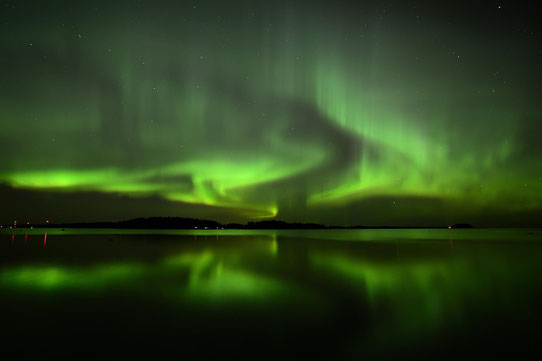
Snowmobile rides & lakefront cabins – chase the lights across frozen wilderness or watch them reflect on a silent lake.
At Mökki Tikka by Koirajärvi in Ranua, you don’t need a tour bus – you can see the northern lights directly from the sauna pier or your cabin terrace, with nothing but forest and frozen lake around you.
Key Takeaways
-
Auroras happen when solar particles collide with Earth’s atmosphere.
-
Best time to see them in Finland: September–March, after 10 PM.
-
Lapland offers some of the world’s most reliable conditions, with up to 200 nights per year of visible auroras.
-
Silence, dark skies, and clear weather are the keys to an unforgettable show.
Kommentar schreiben